Category Archives: Introductions

An Introduction To Odinani

Standard

By Chimdi Nobim

What is Odinani?

Odinani (also called Odinala in some dialects) is the ancestral spiritual science of the Igbo people of Nigeria. Literally translated it means “It is in the Earth/land”, referencing the traditional Igbo belief that Ani/Ala the Earth Mother Goddess is central to our very existence and to progress in all endeavors. Odinani/Odinala should not be confused with Omenani/Omenala, which are the social elements(customs and traditions) of Igbo people, although there are obvious links between the two, as spirituality is often the basis for all other cultural elements.

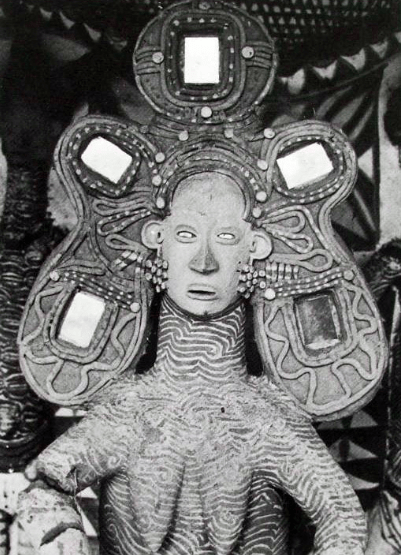
Symbol of Ala, the Earth Mother, among the Eda Igbo, present-day Abia or Ebonyi State. P. A. Talbot, c. 1920s.

What are the basic tenets of Odinani?

In Odinani it is believed that everyone is a spiritual being(mmuo) born into a physical body(mmadu) to accomplish a destiny on Earth, or to acquire experience. At the center of our being is Chi, the divine spark that is our true self and that guides us from within, and is our link to the Supreme Being And Source of All Life known as Chineke, which has a masculine part called Chi Ukwu(Great Soul) and a feminine part called Eke. While Chi Ukwu is the source/collective of all Chi, Eke is Creation herself and sustains and nurtures all life within the universes contained in her Cosmic Womb. The Earth, Ani/Ala, is therefore an extension of the Divine Mother Eke.

Playing with Time and Memory. A series of four acrylic on canvas paintings, each 101x101cm, by Chuu Krydz Ikwuemesi, 2020

The Divine Mother extends herself into forces of nature that regulate life as we know it, and these forces are personalised as deities(called Agbara, Alushi or Arushi depending on dialect). Some common examples of these deities are:

Ihejioku/Ifejioku – deity of Agriculture
Omumu – deity of fertility
Ekwensu – deity of warfare
Amadioha – deity of justice
Onwa – deity of the moon
Anyanwu – deity of the sun
Nnemmiri/Oshimmiri/Idemili – deity of the waters
Arobinagu – deity of herbs
Agwu – deity of wisdom, knowledge and divination

This list is in no way conclusive as the number and functions of deities vary from community to community. Practitioners of Odinani invoke these deities on matters considered to be under their respective jurisdictions. Reincarnation is a central belief of Odinani, as it is asserted that a person incarnates repeatedly, usually within a family, until certain tasks are successfully accomplished. Once accomplished, the individual takes his place amongst other ascended ancestors to guide and watch over descendants, provided said descendants are receptive to their guidance.

When a person incarnates, his previous incarnation is called onyeuwa, and it’s believed that the onyeuwa can be accessed and invoked to assist the individual in achieving the task that brought him/her back. In Odinani it is also believed that humans are not alone in this world, neither is this world the only one. Surrounding us are subtle realms not accessible to our physical senses, which are populated by sentient beings. Actually many of us on Earth as humans today lived in those worlds before our birth into this one, and we have friends and families there. These beings are called mmuo in Igbo, also known as fairies/jinns/elementals/wee folk in other languages.

As we are all children of the Divine Mother whose worlds interface, our primordial ancestors established relationships with these spirit beings, much like treaties are established between nations, for mutually beneficial cohabitation, and just like treaties are inherited by successive governments and people of a nation, so also do we inherit these covenants made with other worlds from our ancestors. Some of these spirits serve as guardians for clans and communities, and in return we are expected to honor or repay them in several ways which depend on the initial ancestral agreement.

Is worship part of Odinani?

In worship one is expected to give of oneself to another being on the assumption that this being has a right to demand it of us, no questions asked. Also in worship one is expected to beg or grovel before another in hopes that the latter will answer our requests based on their own whim.

Masquerades from different cultural regions of the Igbo area photographed by G. I. Jones in the 1930s.

However, in Odinani, we seek only to align with our true nature, Chi, and be receptive to its guidance. We do not believe Chineke our Supreme Being or any other force requires worship, how do you give anything to The One that is the Source of Everything? We also do not believe that Chineke is a vain and insecure entity that needs to be placated, cajoled or flattered.

While a casual onlooker might conclude that we “worship” the deities subordinate to the Supreme Being,.as well as spirits we interact with, we do not. We relate with deities and other spirits on a transactional and not devotional level. Life is balance, we give to receive, we provide value in order to get value, and this is true for all relationships where needs must be met. This is the essence of sacrifices and offerings in Odinani, which will be covered in more detail later. The offerings and sacrifices provide energies with which our spirit allies are equipped and compensated for their work, they are not materials for worship.

What are some misconceptions about Odinani?

  • Odinani involves devil worship or pacts with demons: This is misinformation begun by European missionaries and propagated till today by those who accepted and follow their religion. The demonization of our ancestral ways was a politically motivated effort to undermine the Igbo traditional structure and thus reestablish a new colonial power base centered on foreign ideologies that served the interest of the Europeans. It is unfortunate that the agenda continues with those descended from the early Igbo converts to Christianity maintaining the castigation of the systems their pre-colonial ancestors put in place. However, we are glad to note that more and more are awakening to the light and challenging the narrative, embracing the ways of their ancestors in the process.
  • Odinani involves human sacrifice: No civilisation, race or tribe can deny their involvement in practices that we would call unsavory today, and Igbo people are no exception. While it is true that humans may once have been sacrificed in some parts of Igboland, it is not the case today. Let us also bear in mind that even foreign religions cannot boast of clean hands in their past either, as their own history almost literally drips with blood. The point is that systems are meant to evolve for the better, and Odinani is no exception.
  • Odinani supports criminal activity: Sadly due to the present economic state in Nigeria, some practitioners have turned to misuse of their knowledge to seek shortcuts to material success. This however is not the true way of Odinani and should not be used as a lens through which to view all who practice it. Anyone who engages in acts that bring harm or loss to others will face Divine Justice eventually and will suffer dearly for their misdeeds. Efforts are being made continuously by sincere practitioners to educate their wayward colleagues on the proper, harmonious, and generally beneficial ways to practice science. It should be noted at this time that the purpose of Odinani is to align you with your destiny and the forces that can help you achieve it, not to make you rich or give you the power to harm others or destroy enemies. Whatever is needed to ensure your personal fulfillment, be it wealth, power or protection, then follows provided you are well aligned and you maintain it.
Okoroshi masquerade 

Getting Started in Odinani

  • Go to your ancestral Igbo community: this is based on the assumption that one is of Igbo descent and has access to their ancestral homes, elders and practitioners of Odinani there. While the basic tenets of Odinani are general amongst Igbo people, some practices and spirit alliances are unique to families and communities, and as such it is best to familiarise oneself with ones own ancestral spiritual structure.
  • Go for Afa(divination): in Igboland, we have certain persons known as Dibias who are specialists in various fields related to the spirit world. One, in particular, is called a Dibia Afa and he/she can access the spirit realm and give you information about yourself and your relationships with the other side, to guide you on what you should do to align with your Chi, ancestral spirits and other spirit allies.
  • Begin to practice Igo Ofo: This is probably the most important step you can take in beginning your journey. Igo ofo is the traditional Igbo way of communicating with your allied spirit forces and should be done daily or at least regularly. As you acknowledge your spirit allies they begin to work with and guide you on the right path to fulfilling your destiny. No matter what rituals or divination you do and if you do not personally seek to establish and maintain intimate relationships with the spirits that follow you, it will be a waste.

10 Year Anniversary of IgboCyberShrine & Special Announcement

Standard

This month marks the 10 year anniversary since I began this blog, and to celebrate, I’d like to take you on a journey through time, highlighting the past, the present and giving you a glimpse of the future.

A decade ago, I was sitting in class, halfway paying attention to my thermodynamics professor, and halfway counting down until the end of the lecture. All of a sudden something triggered a portion of a dream I had the night before, and things haven’t been the same for me since.

In my dream from the previous night, I had a conversation with a goddess. The figure was tall and very majestic looking. Her face was covered in white and she wore a regal hairstyle. I recognized her as Ala, the earth goddess, and the most important spirit to Igbo people. 

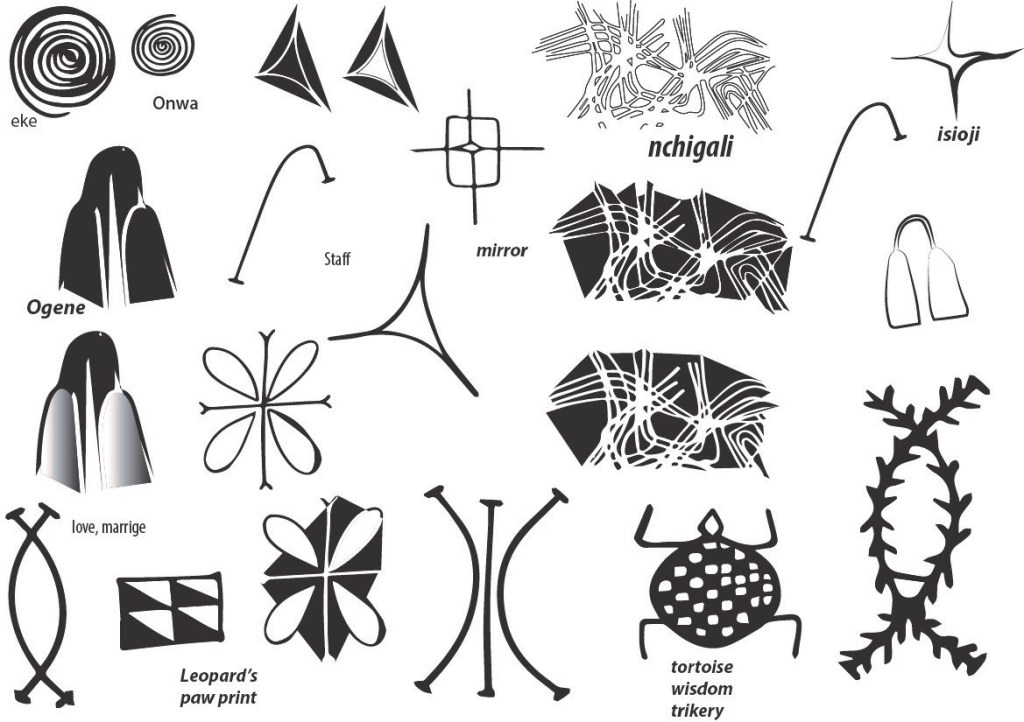
In our conversation, I remembered her explaining to me that her symbol was a lozenge.  I was surprised by this revelation. I had surmised that the symbol of the Earth mother would have been a circle engulfing a cross. I went home and found out that the lozenge was indeed the symbol of not just Ani…but of the Mother goddess in other parts of the planet.

After that revelation, other symbols began to make sense to me almost intuitively. I was understanding so much so soon that I felt like I’d go crazy if I didn’t  share it all. Hence, that was the genesis of Igbocybershrine.

In the time since that first dream, I’ve had several other inspirations, and even managed to inspire others to write down their insights too. When the site first launched, there weren’t many resources for finding authentic information about Igbo culture or spirituality. However, now there are countless videos and articles that are related to these topics, including quite a few that directly or indirectly reference this site.

However, my friends, I must confess that there was a time when I was feeling unmotivated and nearly walked away from it all, but what brought me back was getting a few emails from readers asking me where I was, and letting me know how important this site had been for them.  I’ve realized that in the past 10 years, a community has been growing full of over 1000 subscribers and a couple of content creators. The site gets hundreds of views a day and we get messages from people all over the world. This cyber shrine has become the center of a digital village.

One challenge I’ve faced over the years has been presenting practical information that would be relevant to people today, especially those who live outside of a village environment. Most of what I was learning had to do with the beliefs and practices of people who lived in a time and environment that no longer exists. But I would constantly ask how many of the lessons could be applied to the issues of today, and how they could prepare us for tomorrow. 

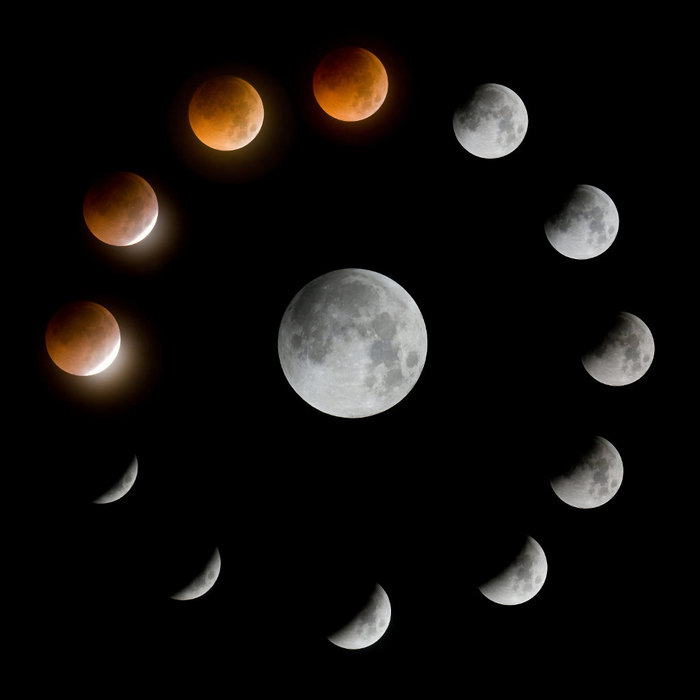
After taking alot of time to reflect, I came up with a framework that I feel can be very beneficial for people today. I decided to base it off the “12 step” programs that I had seen many people utilize to transform their lives for the better. I took time and utilized Igbo principles as well as some of my own spiritual experiences to map out each step. And to keep it in line with Igbo culture, I added an additional step, bringing the total to 13, which is the number of months in the Igbo lunar calendar.

So umu nnem (brothers and sisters), I’d like to invite you to join me as I spend the next lunar year delving into each step, and detailing how you can apply the lessons in your life right here and now. The first step will be covered during the next new moon, which will fall on the 18th of August. Stay tuned and stay blessed!

Nkele Egede: In Praise of the First Ones

Standard

Nkele Egede

(Igbo Translation)

Lekwe anyanwu biara uwa,

Ihe ebi-ebi ka o Jiri choo ya mma.

Mmadu Jizi maka nke-a hu ya na-anya.

Aja-Ala, Nne mbu buru anyi n’afo izizi,

Anyi echeta gi.

Igwe na mmiri,

Ndi mbu lere anyi omugwo,

Ndi mbu biara abia na ogodo uwa.

Anyi echeta unu.

Ikuku na Okpoko, ndi mbu fere efe,

Ndi obu-akika-na-enwu-oku n’isi,

Ndi mbu lara agu n’asaa na mmiri n’asaa,

Were nu nke ru-ru unu.

Debe nu Chim na Chi uwam.

Uwam biara, lekwem.


In Praise of the First Ones

 (English Translation)

Now behold the Magnificent Sun,

The One who came forth and blessed the world with eternal light.

Oh—how endless our adoration.

Behold too, the motherly Earth,

From whose primal womb we’ve all emerged and continue to emerge,

How endless our appreciation.

Behold now, the very ancient Sky and primal Waters.

The most graceful ones who first suckled and guided us,

The manifest ones who first embraced the visible world.

How endless our adoration.

Behold the sacred Spirit that is Breath and its chosen bird, Okpoko.

Behold both earliest of all adventurers; inventors of the art of flight.

Behold them, the non-flammable head-bearers of Light—

Primal navigators of the Seven Wilderness and Seven Seas.

Oh—ancient ones of renown, how endless my appreciation.

Guide now, my Chi and the Chi of my Destiny.

Great manifested world, bear me well.

—Nze Omenigbo Izo

(Excerpted from “The Transfiguration of Izo and Other Mystical Feats: Poems”)


Music. Dance. Spirit.

Standard

Igbo Women Playing Udu Drum

By Ezi

For most people, when they think of music (egwu) the immediate things that come to mind involve some form of technology that outputs a song which contains vocals and/or instrumentation. They may think of their favorite artists or songs and hum their tunes. But, I see music as not only something that emanates from my headphones day in and day out, but also sounds, unrefined at times, that emanate from not only within me, but within the environment. Everywhere around you there exists sound and essentially music, if you can open yourself up to a wider definition of what music is and where you can locate it.

There is a rhythm to life. The birds chirping, the sway of an ocean’s waves. The rhythm of 1,000 feet hitting the pavement on their way to work.

Music – vocal, instrumental, or mechanical sounds having rhythm, melody, or harmony

Rhythm – The pattern or flow of sound created by the arrangement of stressed and unstressed syllables in accentual verse or of long and short syllables in quantitative verse

I will dare to say this and you can quote me, that when it comes to instruments, the drum is the pulse of Africa. From East to West, North to South.  Whether it is the ekwe, the djembe, the bata, or the ngoma; the drum operates as that rhythmic pulse, in my opinion. In lieu of the physical drum, the body is also a drum. The body is an instrument, so why then can we not imagine it as a drum? Touch your inner wrist. Do you feel your pulse? Or simply listen to yourself and you will hear your pulse.

For me, when my body is in sync with the instruments that I hear in a song, that is when I can have the most enjoyable and spiritually pleasing experience with music.

Some questions that usually come to mind:

1) What message(s) is this song trying to convey to me?

2) Who is delivering this message(s)?

3) What effect is this song having on my mind, body and soul?

Music is a fundamental component in the way of life of African people.

“Music usually accompanies African religious ritual and is used in prayer to request favors or help from the spirit world. The drum unlocks communication with the spirit world.  Songs are usually accompaniedby the beating of drums and the playing of other instruments.” (Aloysius M. Lugira, African Traditional Religion, p. 74-75)

The beauty in music is that it has a very attractive quality that allows it to be retained in the mind. You can hear a song and it can stay in your head for however long. You may not remember every lyric, but you certainly may remember the melody, the memory attached to the song, as well as what you felt when you heard the song.

When you listen to music, wherever you find it, ask yourself what is the message(s) being conveyed in the song, who is conveying this message(s), and what kind of effect the music has on you.


Introduction to Odinani

Standard

by Omenka Egwuatu Nwa-Ikenga

Who are the Igbo people

Ndi Igbo (the Igbo people) are a West African ethnic group who trace their homeland to an area of what is  now known as southeastern Nigeria. They are known for their rich, vibrant culture and history, and they have been the subject of many world renowned works of both fiction and non-fiction including Chinua Achebe’s Things Fall Apart, Ifi Amadium’s Male Daughters and Female Sons as well as The Interesting Narrative of the Life of Olaudah Equiano.

There have been Ndi Igbo occupying their present location for over 8000 years, and they have left behind such artifacts as the Igbo Ukwu scuptures, which are the earliest of their kind found in West Africa, as well as the Nsude pyramids which resemble some of the step pyramids of ancient Egypt and Sudan. For a large portion of its history, Alaigbo (Igboland) did not have a central authority, and within it existed many states including the medieval Nri kingdom and the more recent Onitsha and Arochukwu kingdoms, although the Arochukwu confederacy did have a considerable influence over Alaigbo for a few hundred years.

Nsude pyramids

The Maafa (Transatlantic Slave Trade) removed hundreds of thousands of Igbos from Alaigbo, placing them in significant concentrations in colonies that would eventually become the countries of Sierra Leone, Liberia, Haiti, Jamaica, Trinidad, Cuba, Barbados, Belize, Grenada, as well as the United States. These Ndi Igbo did not come empty handed, but carried with them their Omenala (customs and traditions), their Odinani (spiritual sciences), and their unbreakable wills. Their descendants helped play  key roles in such slave uprisings as the Nat Turner Rebellion as well as the Haitian Revolution.

The Maafa was the beginning of the colonization process of Alaigbo by the British, which they resisted through numerous battles such as the Anglo-Aro Wars, the Ekumeku rebellions, the Aba Women’s riots and culminating in the Biafran War. It was not until 1970 that Alaigbo was under the total control of  the (neo)colonial state of Nigeria. As a result of slavery and colonization, the lifestyles and practices of the majority of Ndi Igbo and their descendants has dramatically changed.

What are Omenala & Odinani?

Historians like to perpetuate the idea that Africans who ended up in the so called New World lost their African culture, which stems from the fact that most Diaspora Africans do not speak the exact same languages of their ancestors, eat the exact same foods, or practice the exact same spiritual systems. However, just because something is not exactly what it was previously does not mean it is has become “lost.” Customs and traditions, like everything else, can go through transformations and adaptations, especially when they are carried to a new environment and people undergo new experiences.

There are also many voluntary African immigrants that now live in North America. These people do not live the same way that they did in Africa, and their children do not have all of the same practices and ways of thinking that they have. The food eaten is often different, the clothing worn is different, and the language might not be passed from one generation to the next. However, you can still analyze them and make a conclusion about where they came from without too many problems. If so much can be changed in just one generation from a voluntary immigration, how much would be transformed from many generations after an involuntary one?

"Other African Americans"

Even when historians admit that some African cultural practices were retained, they will systematically ignore (either directly or indirectly) the Omenala of the Ndi Igbo, especially as it pertains to their descendants in the United States. Historians will admit that Ndi Igbo did come to the “New World” but seldom ever speak on the practices that are derived from them. Rather, they attempt to paint the majority of the Diaspora as being either Yoruba or Akan.

The reality is that the majority of the Diaspora was not Yoruba or Akan, and the Ndi Igbo comprised a significant portion of it. Secondly, the practices of a people in the Diaspora are not always a signifier of who they trace their ancestry from. There are many Africans of Igbo descent in the Diaspora that practice the Yoruba religions because of the fact that the strong central organization of that particular system, as well as the ones of the Bakongo and Fon/Ewe, made them more apt  to flourish in the Diaspora.

Likewise, there are people of Igbo descent in Africa that practice the Roman religion called Catholicism or the British religion called Anglicanism, but neither of these groups of Igbos are from Rome or Britain. Furthermore, the idea that the traditional religions are dead in Alaigbo or in the rest of Africa is more misleading propaganda that people fail to double check on. If the traditional religions are really dead then why do all the African “traditional healers”, “medicine men”, diviners and priests still have so much clientele, even in predominately Christian or Islamic nations? As embellishing as Nollywood (the Nigerian film industry) can be at times in its portrayal of Nigerian life, this is one thing that they are not exaggerating. The fact is that regardless of what imported tradition an Igbo (or any other African) may practice, when it begins to fail them, they will go back to the Omenala of their forefathers and foremothers that provided results.

The Re-Awakening of Omenala & Odinani


Today, with the advent of DNA testing that allows people to trace their ancestry, more and more Africans in the Diaspora are uncovering their Igbo genetic heritage, and seeking to learn more about the Omenala of their Egwugwu (ancestors). However, a careful analysis will reveal that they don’t have to visit Alaigbo to discover them, as they are literally right in front of their faces in the traditions and habits that they already know and cherish.
Likewise, Nollywood is helping to spark a renaissance in interest in the Omenala of Ndi Igbo within Africa, by producing alot of films that take place in pre-colonial Alaigbo. These movies often feature Igbo language, traditional attire, make-up, and other things pertinent to Omenala. Authors like Chimamanda Ngozi Adichie (Half of a Yellow Sun) are helping to build the Igbo renaissance in the literary field by picking up the torch originally carried by people like Chinua Achebe.

Forest Whitaker & Danny Glover reclaim their Igbo heritage

This blog was motivated in part by  the developing Igbo Renaissance, and the growing need to reclaim the Omenala of the Igbo both in the Diaspora and the Motherland.  However, simply reclaiming and reviving Omenala is a drop in the bucket. The most vital thing is to reawaken the Odinani. Whereas Omenala can be paraphrased as “what you do”, the Odinani is “why you do it.” This fundamental relationship is the key to not only reviving old traditions and practices, but creating new and better ones that can raise the state of our people wherever they may be.

The vast majority of the people in the world today have beliefs, practices and traditions that they uphold but lack understanding about. Consider yourself as an example. Why do you feel the way you feel about certain things? Why do you believe what you believe? Who defined your values? Who is the one that designed your lifestyle? Have you ever thought about these things?

Likewise, when it comes to conditions  in society or in the world as a whole, people often don’t think about the root causes of things; why things are the way that they are. They simply just accept definitions given to them by their religious leaders, social scientists or politicians. What we call religions today are not much more than the deification of a culture of a people. People can’t tell the difference between their cultural practices and the principles that caused them to come into existance.

Odinani was the means through which the Ndi Igbo sought to understand their natural environment. In pre-colonial times, their worldview was limited to their village and their surrounding villages, so their definition of Odinani would have been “laws of the land.” However, with the dramatic expansion of the Igbo worldview that came with colonization by the Europeans, a more appropriate translation of Odinani would be the laws of the Earth, or the laws of Nature. We know this today as science.

Observation

According to Webster’s Dictionary, science is defined as “a systematic knowledge of the physical or material world gained through observation and experimentation.” By this definition, Ndi Igbo, much like other African people, were scientists in the true sense of the word. They were master observers, able to pick up the minutest of details as well as things right in plain view that often go overlooked by most people. Ndi Igbo were also practical people who adopted traditions after they had been tested and found to produce results that could be reproduced. They did not have time for theories that had not been demonstrated or for blind faith in anything. However, there were two major differences between their view of science and the Western view. Those are, the fact that they did not separate the spiritual from the physical, and that they were also intelligent enough to never claim to have discovered anything.

Ndi Igbo knew what scientists are now finding out: that all matter in the universe is energy, that vibrates at certain frequencies. What we call the physical world is matter that is vibrating at a lower frequency. When the frequency increases, things can become inpercievable to us, even though they are still there. An example of this would be radio and television waves.  Matter at a  higher vibration is what the ancients called spirit. The understanding of the science of spirit is what we would call metaphysics, which is defined as “the theoretical or first principles of a particular discipline.” In other words, metaphysics is the first cause of everything in the physical.

Although Ndi Igbo, as well as other African people have produced their own Leonardo DaVinci’s, Issac  Newtons, Albert Einsteins, etc, these African people did not take credit for finding out about things that have always existed, as Europeans have a very nasty habit of doing. The very notion that an individual “discovers” anything in nature, be it a place (especially one that is already inhabited), a thing, or a concept, implies that no other people that lived before knew it, or that that individual has some type  of “ownership” over it. Ndi Igbo, like other Africans, acknowledged that they did not discover anything, they simply became aware of something that had already been there. Every other year, a new “discovery” by the Europeans renders their old “discoveries” null and void, which goes to show that they are not “discovering” anything at all, but simply uncovering a “bigger piece of the pie.” In regards to Odinani, one good way to describe it would be as a process of becoming aware, of ones self, and of reality.

In conclusion, I would like to say that if Omenala were a play, Odinani would be the script. If Omenala were a software program, Odinani would be the source code. If Omenala would be the actions one takes in response to the changing seasons, then Odinani would be the cyclical  nature of the seasons themselves. The customs, traditions, and rituals that you have will change depending on season or environment, but the laws of nature themselves remain the same. And as you read the articles written by different authors, and view the different symbols and works of art that are posted and deciphered, you should be aware that nothing that is being shared should be considered true unless you can research it, observe it, and prove it true to yourself. Yagazie (May we prosper).